


How to Choose a 3PL in Australia: 12 Questions That Reveal Where a Provider Will Break
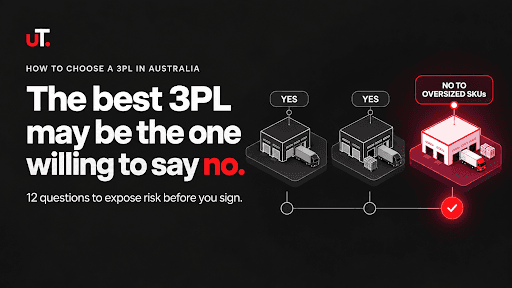
It’s one of the most common questions in 3PL selection, and one of the least useful.
Any provider that’s reached your shortlist is likely to say yes. The commercial incentive is obvious. Capability is interpreted broadly, limitations remain unspoken and the difficult details are deferred until implementation.
So a better question is:
What would make our operation a poor fit for you?
The answer may be less reassuring, but it will also tell you considerably more.
Choosing a third-party logistics provider is not simply a search for warehouse space or a competitive pick-and-pack rate. It’s a decision about who will carry your inventory, fulfil your customer promise and absorb (or return) the operational pressure when reality departs from the forecast.
The best 3PL may therefore be the one willing to say no.
The warehouse decision is becoming more consequential
More Australian businesses now depend on the warehouse as part of the customer experience.
Australia Post reports that Australian consumers spent $82.6 billion online in 2025, up 14% year on year. A record 82% of Australian households shopped online, while 69% of shoppers wanted a choice of delivery options at checkout. When a purchase was urgent, 26% expected same-day or next-day delivery. Australia Post eCommerce Report 2026
These expectations travel backwards through the supply chain.
A delivery promise made at checkout becomes a cut-off time in a warehouse. A promotion becomes a labour and capacity requirement. A broader product range becomes more storage locations, replenishment activity and picking complexity.
At the same time, the physical freight task continues to grow. Infrastructure Australia expects metropolitan road freight to increase by 42% in Melbourne and Perth, 36% in Brisbane and 27% in Sydney between 2024–25 and 2040. Road already carries almost 80% of Australia’s non-bulk freight. Infrastructure Australia
Technology is changing the operation too. Gartner’s recent supply chain research identifies autonomous data collection, intelligent simulation, agentic AI and increasingly adaptable warehouse robots among the technologies reshaping the sector. Gartner
This doesn’t exactly make 3PL selection easier. Far from it.
A technologically sophisticated warehouse may offer better visibility and productivity. It may also require deeper integration, longer implementation and less commercial flexibility. A provider with space available may not have the labour, systems, equipment, location or operating profile required to serve a particular customer well.
Basically, available space isn’t the same as suitable capacity.
Why conventional 3PL selection misses the real risk
Most selection processes are designed around the expected operation.
The buyer provides average order volumes, pallet numbers, SKU counts and forecast growth. Providers return a proposed solution based on those assumptions. The buyer compares prices, capabilities, references and service levels.
This is sensible, but it’s also incomplete.
Average figures smooth out the conditions that place the greatest pressure on a logistics operation. They don’t show what happens during a promotional spike, an unexpected product launch, a transport disruption or a systems outage.
They don’t reveal whether a provider’s other customers peak during the same period. They don’t show whether additional labour is genuinely available. They rarely explain which charges will change when the order profile changes.
The proposal may describe the operation accurately and still fail to describe the risk.
That matters because a 3PL quote isn’t just a price. It’s an allocation of uncertainty between two businesses.
A low storage rate may sit alongside higher movement charges. A competitive fulfilment fee may depend on minimum volumes. Automation may lower unit costs while requiring a longer commitment. Flexible capacity may carry a premium because the provider is accepting more demand risk.
Comparing 3PL quotes without understanding these mechanics is like comparing insurance policies by premium while ignoring the exclusions.
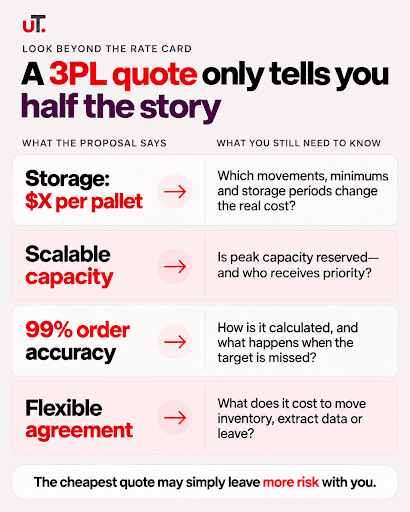
The cheapest option may not be more efficient. It may simply leave more risk with you.
The purpose of due diligence is to find the mismatch
Buyers commonly use due diligence to confirm that a provider can meet the brief.
That creates a subtle problem. Confirmation invites evidence that supports the match: customer logos, polished case studies, warehouse tours and demonstrations conducted under controlled conditions.
A stronger selection process tries to disprove the match.
This doesn’t mean approaching providers with suspicion. It means recognising that incompatibility is usually cheaper to uncover before inventory is moved, systems are integrated and customers are affected.
The aim isn’t to find a provider with no limitations. Such a provider does not exist.
The aim is to find one whose limitations are understood, acceptable and reflected in the commercial agreement.
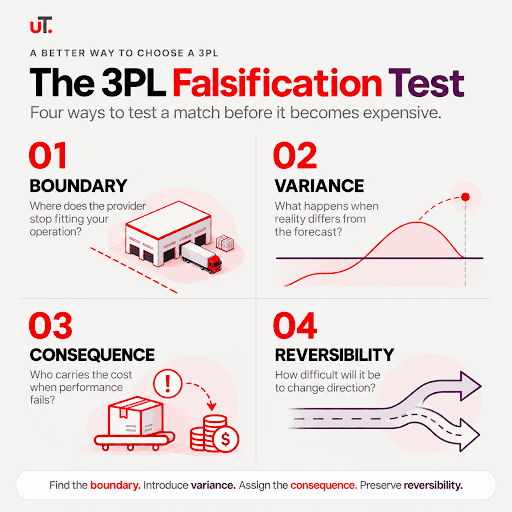
The 3PL Falsification Test
A useful way to assess a 3PL is to test the proposed relationship across four dimensions:
- Boundary: Where does the provider’s operating model stop fitting yours?
- Variance: What happens when reality differs from the forecast?
- Consequence: Who carries the cost when performance fails?
- Reversibility: How difficult will it be to change direction?
Together, these tests turn a sales conversation into an operating assessment.
A simple way to remember them is:
Find the boundary. Introduce variance. Assign the consequence. Preserve reversibility.
Here are the 12 questions that bring this framework to life.
Boundary: establish where the fit ends
1. Which of your current operations most closely resembles ours?
General sector experience is not enough.
A provider may serve several ecommerce brands without handling an operation with your SKU count, order profile, item dimensions, returns rate or dispatch requirements.
Ask for relevant similarities and material differences. Explore volumes, channels, handling requirements, seasonality and technology.
A credible answer should be specific. “We work with retailers like you” is a category claim, not evidence of operational fit.
2. What would make us a poor-fit customer for your operation?
This is the most revealing question in the selection process.
A strong provider should know which customer profiles create friction inside its network. It may struggle with oversized products, highly variable volumes, slow-moving inventory, complex kitting or unusually late cut-off times.
Listen for precision rather than reassurance.
A provider that can describe its boundaries probably understands its operation. A provider that claims to accommodate everything may not have examined the requirement closely enough.
3. How will our systems connect, and what happens if the integration is delayed?
“Integration available” can mean anything from a mature standard connector to a custom project that hasn’t yet been scoped.
Ask which systems have been connected before, who owns implementation, how data will be validated and what the fallback process will be.
You should also establish what operational information you will be able to access. Inventory, orders, exceptions and performance data should not disappear behind a provider’s internal systems.
The cyber dimension matters as well. The Australian Signals Directorate advises organisations to map supplier dependencies, define supplier obligations and control access to their networks. It also notes that cyber risk can pass through the supply chain to customers. Australian Cyber Security Centre
System access is therefore not only an implementation question. It’s a risk question.
Variance: test what happens when the forecast is wrong
4. What capacity is genuinely available to us during peak periods?
A provider may have enough space today without being able to guarantee space when you need it most.
Ask how capacity is allocated across customers, whether space is reserved and what happens when several customers peak together.
The same applies to labour, equipment, loading docks and carrier collections. Storage capacity alone does not determine throughput.
The evidence should be operational: capacity plans, historical peak performance, labour arrangements and clear volume thresholds.
5. How do you operate when demand exceeds our forecast?
Forecasts are necessary. Forecast accuracy is never perfect.
The important question is how the provider responds when actual demand falls outside the agreed range.
Ask what triggers additional labour, whether cut-off times change, which orders take priority and when the provider will alert you that service is at risk.
This is also where location and transport resilience matter. Infrastructure Australia found that eight of 52 critical road freight routes assessed had high or very high vulnerability, with storms, flooding and heat among the main hazards. Infrastructure Australia
Not every operation faces the same exposure. But providers should understand the dependencies around their facilities and have credible alternatives when those dependencies fail.
6. Which prices or service conditions change when our profile changes?
Do not model cost against one forecast.
Request scenarios for normal demand, peak demand and material underperformance against forecast. Include changes in order size, SKU count, storage duration, returns and value-added services.
Ask which fees are fixed, variable, indexed or subject to minimum commitments.
This converts the rate card into a commercial model. It also reveals where the provider has placed the risk of volatility.
Consequence: turn promises into commitments
7. How is each service level calculated?
“99% accuracy” sounds useful until the calculation is examined.
Does it refer to orders, units or lines? Are customer-caused exceptions removed? Which system is the source of truth? When does the measurement window begin and end?
Every material KPI should have a definition, data source, reporting frequency and exception policy.
Otherwise, the buyer and provider may agree on the target while measuring different things.
8. What happens when a service level is missed?
A dashboard records performance. It does not improve it.
Ask how failures are investigated, how corrective actions are assigned and when senior leaders become involved. Establish whether repeated failure produces service credits, remediation obligations or termination rights.
The goal isn’t to construct a punitive agreement. Excessive penalties can create defensive behaviour and arguments about exclusions.
The goal is to create consequences strong enough to support accountability.
Good governance matters because no contract can predict every operational problem. The contract should define how the parties make decisions when the planned process stops working.
9. What are your continuity, compliance, cyber and financial-risk controls?
Outsourcing an activity doesn’t eliminate the buyer’s exposure to it.
Depending on the operation, diligence may need to cover insurance, dangerous goods, food safety, temperature control, product security, modern slavery obligations and transport compliance.
Under Australia’s Chain of Responsibility framework, responsibility is tied to the influence and control a party has over transport activities. Businesses should not assume that engaging a logistics provider automatically removes their own obligations. National Heavy Vehicle Regulator
Continuity planning should include systems outages, site disruption, loss of critical staff, carrier failure and provider financial distress.
Ask for evidence that controls are active. A policy document written several years ago is not the same as a tested recovery process.
Reversibility: protect the ability to change
10. How would the operation change if our business grew, contracted or became more complex?
Scalability is often treated as another version of growth.
Businesses also contract. They close channels, reduce inventory, acquire companies and change product ranges. A suitable agreement should explain what happens in both directions.
Ask how different volume bands affect pricing, capacity and service. Establish whether a major change triggers renegotiation or creates a right to terminate.
Flexibility should be defined before it’s needed.
11. Where will automation help, and what constraints will it create?
Automation is not inherently a reason to select or reject a provider.
The relevant question is whether the technology suits your order profile and whether the economics remain attractive across realistic demand scenarios.
Ask who funds dedicated equipment, who owns it and how its cost is recovered. Understand whether the solution creates minimum volumes, longer terms or restrictions on future changes.
Technology should follow the use case. Gartner similarly recommends prioritising supply-chain technologies according to business requirements and strategic outcomes, not adopting them in isolation. Gartner
Efficiency matters. So does optionality.
12. How would our inventory, data and operations be transferred if the relationship ended?
This question often arrives too late.
Before signing, establish how stock will be counted, reconciled and released. Define the format in which operational data will be returned. Clarify transition support, outstanding charges and access to any customer-funded equipment.
Review notice periods, auto-renewal, early termination and unilateral price-change provisions carefully.
The ACCC notes that Australian unfair-contract-term protections apply to eligible small businesses using standard-form contracts. It identifies one-sided termination, penalty and variation rights as examples of terms that may be unfair, depending on the contract as a whole. Australian Competition and Consumer Commission
Legal advice remains essential. But commercial teams should understand the operating effect of the agreement, not leave every question to the final contract review.
A clean exit plan does not signal low commitment.
It shows that both parties understand the value of reversibility.
Is this too much diligence?
For some operations, it could be.
A business with low volumes, standard products, limited integration and several credible alternatives may not need the same process as a national retailer or a regulated healthcare supplier.
Diligence should be proportional to exposure.
The required depth increases with inventory value, service sensitivity, regulatory complexity, integration effort and the cost of switching. A small overflow requirement may justify a short assessment. A deeply integrated multi-year relationship requires considerably more.
But proportionality should not become an excuse for ambiguity.
The 12 questions do not need to lengthen the procurement process. Asked early, they can shorten it by removing unsuitable providers before both sides invest in detailed solution design.
What better selection looks like in practice
Begin with an operational brief, rather than a list of desired services.
Include order data, SKU characteristics, inventory profile, inbound patterns, returns, peaks, cut-off times, systems and growth scenarios. Separate current requirements from future possibilities.
Then ask every provider to respond to the same assumptions.
This makes quotes more comparable. It also makes discrepancies more visible. If one proposal is materially cheaper, you can investigate whether it reflects a genuine operating advantage or a different interpretation of the brief.
Request evidence, not additional adjectives.
That may include comparable operating data, sample reports, implementation plans, escalation procedures, security controls and references from customers with similar requirements.
Finally, record the mismatch as carefully as the match.
For each provider, document the conditions under which service, cost or capacity could become unacceptable. These boundaries should inform the contract and the operating governance that follows.
Where uTenant fits
The quality of a 3PL decision depends partly on the quality of the shortlist.
A business can spend weeks conducting rigorous diligence on providers that were never operationally suitable. Informal referrals and familiar names may be reassuring, but they do not automatically account for available capacity, location, specialisation, systems or the customer’s precise handling requirements.
uTenantMatch is designed to make that first stage more structured.
Brands define their warehouse and logistics requirements, then identify relevant providers based on the needs of the operation. The Four-Test framework can then be used to examine the shortlisted options in depth.
Better matching does not replace due diligence.
It ensures that due diligence begins with providers that have a credible reason to be in the conversation.
Choose the provider that knows its limits
The purpose of 3PL selection is not to find a warehouse that can accept your inventory.
It is to understand how another company’s operating model will affect your cost, customer promise and ability to adapt.
That requires more than a rate card. It requires a clear view of where the provider fits, what happens when demand varies, who carries the consequence of failure and how easily the arrangement can change.
Before requesting your next quote, describe the operation in four ways:
Find the boundary. Introduce variance. Assign the consequence. Preserve reversibility.
Then ask every provider the same 12 questions.
The best answer may not be an immediate yes. It may be a precise, well-evidenced explanation of where the provider can perform and where it cannot.
That is not a weakness.
It is one of the clearest signs that you may have found the right match.
Define your requirement and find suitable Australian 3PLs with uTenantMatch.