


Your peak season plan is really a January plan: how to book overflow storage in time
Your peak season plan is really a January plan: how to book overflow storage in time
Most brands plan storage for the run-up to Black Friday. The harder month is the one after Christmas, when returns, unsold stock and new-year imports all land at once, and JLL's latest data shows warehouse space is getting harder to find.
The short version
- Australia Post expects more than 120 million parcels this peak, up 6 to 8% on last year. What goes out in November and December starts coming back in January.
- JLL recorded record warehouse take-up in the September quarter, led by logistics and retail occupiers, while new completions fell to their lowest since 2021.
- The storage crunch for most brands arrives in January, not November. The time to book for January is now.
Why the crunch comes after Christmas
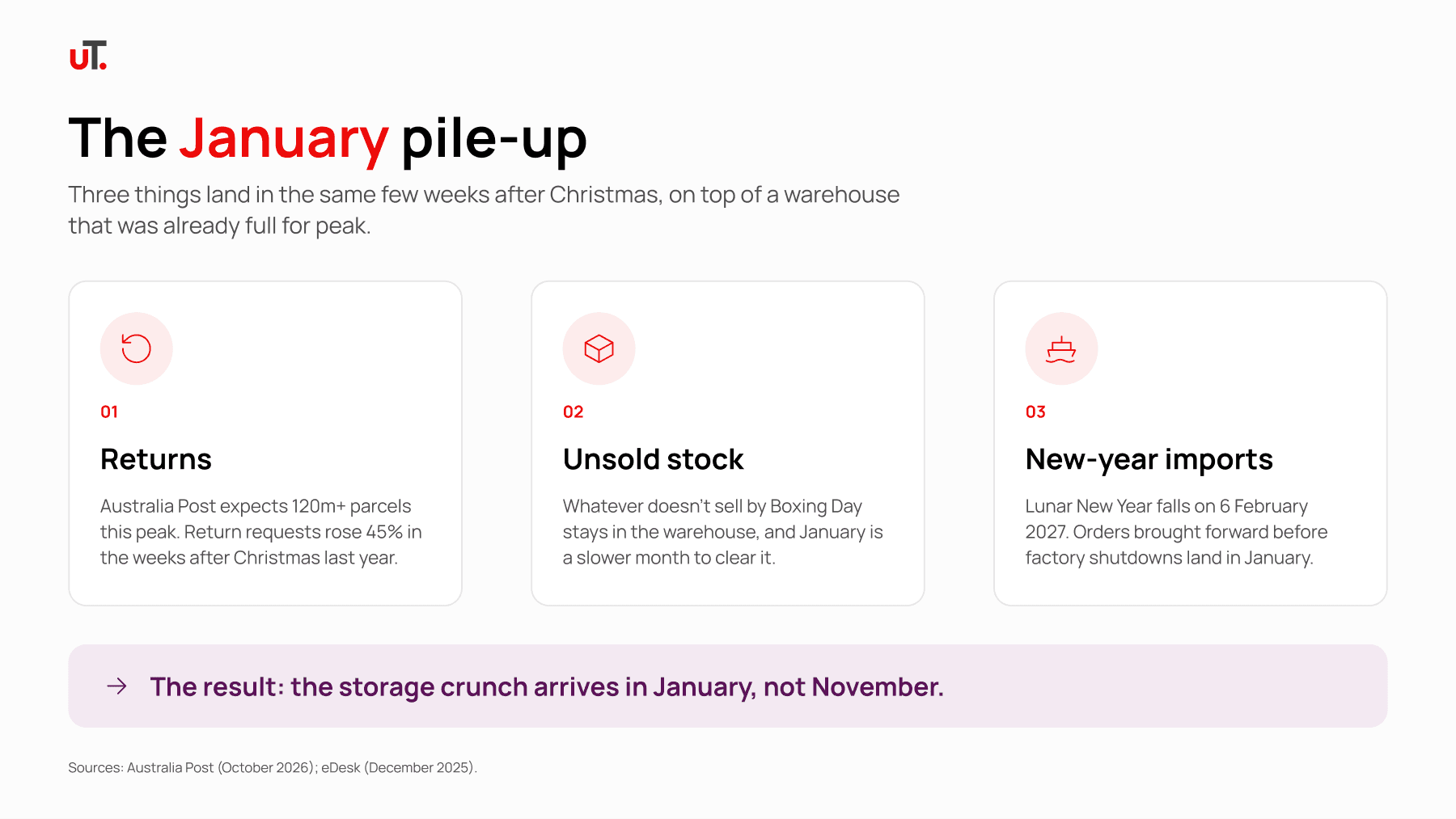
Peak season planning usually ends on 24 December. Stock is bought, space is found, the last parcels go out. Then three things arrive in the same few weeks.
Returns
Australia Post delivered almost 111 million parcels over the 2025 peak, up 7.6% on the year before, with a single-day record of more than 3 million on 8 December. This year it expects to pass 120 million. Every one of those parcels can come back. Customer-service platform eDesk reported a 45% jump in return requests in the weeks after Christmas last year. Returned stock needs to be checked, sorted and stored before it can be sold again.
Unsold stock
Brands buy for the forecast, not the result. Whatever doesn't sell by Boxing Day stays in the warehouse. Australian Retailers Association chief executive Chris Rodwell expects trading to moderate after Christmas, so January is a slow month to clear it.
New-year imports
Lunar New Year falls on 6 February 2027, and many Asian factories close for one to three weeks around it. Importers bring orders forward so stock lands before the shutdown, which puts more containers into Australian warehouses in January and early February.
Any one of these is manageable. All three together, on top of a warehouse that was full for peak, is how brands end up storing pallets in aisles or paying premium rates for last-minute space.
What JLL's latest data says about warehouse space
The space to absorb that surge is tighter than it was a year ago. JLL's research for the September quarter of 2026 shows:
- Record demand. Gross take-up across Australia's five major markets reached 1.49 million square metres, up 20% and 16.6% above the previous record set in late 2023.
- Logistics and retail are leading. Transport, postal and warehousing occupiers, and retail trade, together made up 66.7% of that take-up. These are the 3PLs and retailers whose space brands rely on for overflow.
- Mid-tier logistics is moving now. JLL's Head of Industrial and Logistics for Australia and New Zealand, Nathan Bingham, said demand from mid-tier logistics groups had picked up as businesses adjusted their space ahead of end-of-year sales.
- Less new space is coming. Completions fell 51.5% to 280,400 square metres, the lowest quarterly total since 2021. Of the space still under construction, 70.7% is already committed to a tenant.
- Vacancy is falling. National vacancy fell to 4.6%, and vacancy in prime buildings fell from 4.2% to 3.7%.
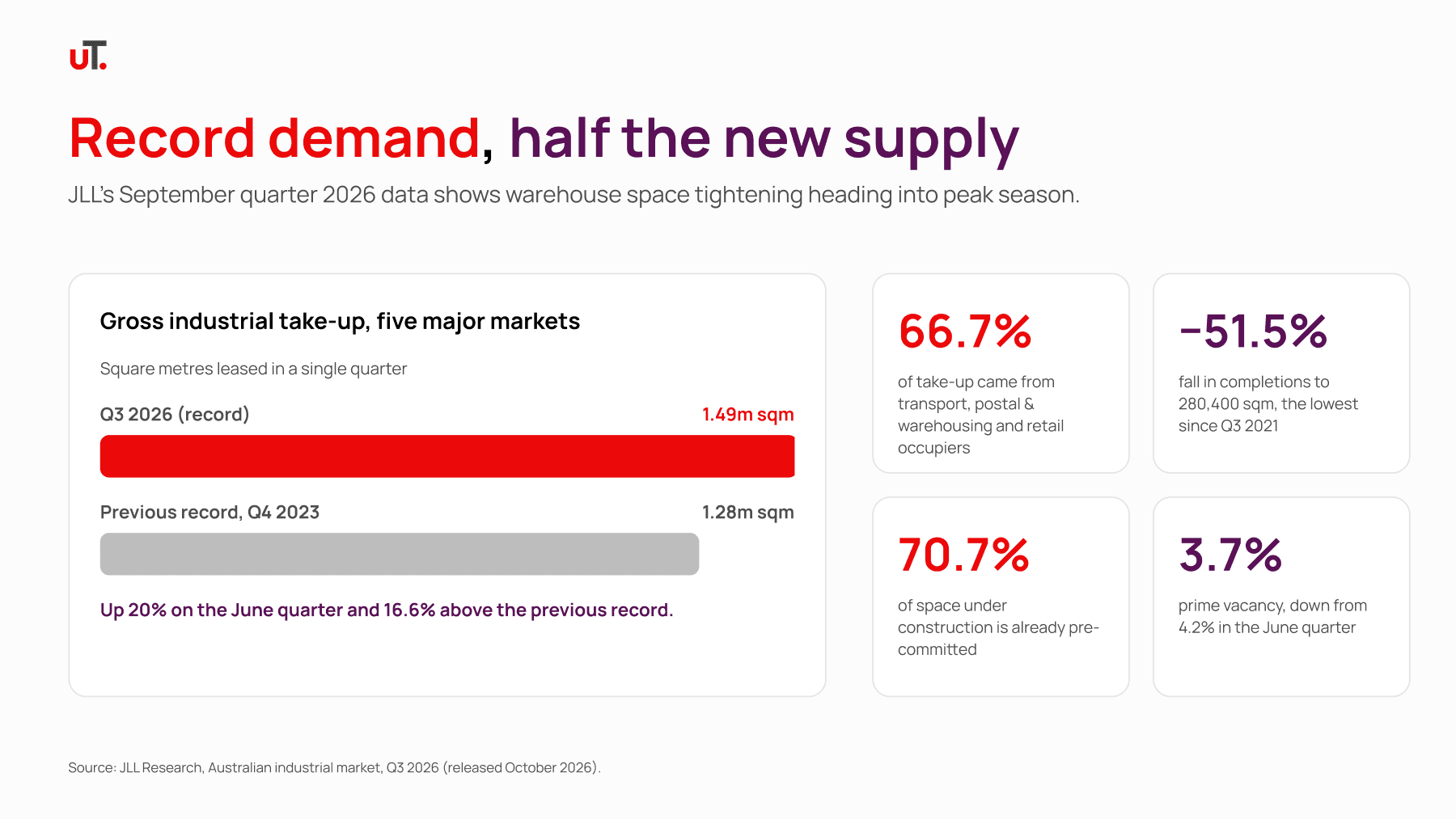
Put simply, the operators brands would turn to for extra space are taking more of it themselves, and little new space is on the way. JLL's Head of Strategic Research, Annabel McFarlane, also noted that smaller operators are less optimistic than larger businesses, so the capacity squeeze may hit smaller brands first.
National figures hide local differences. On JLL's numbers, Perth is the tightest market for warehouse and pallet storage at 1.8% vacancy, while Sydney sits at 5.4% after record take-up of 630,500 square metres in the quarter. Brisbane and Adelaide vacancy rose as new buildings completed, giving brands that need warehouse space in Brisbane or Adelaide a little more choice. Our earlier article, Which vacancy rate is your landlord quoting?, explains why the number for your precinct matters more than the national one.
Why holding stock costs more this year
On 3 November, the Reserve Bank lifted the cash rate to 4.85%, its fifth increase this year. Every pallet sitting in a warehouse is cash that isn't working, and that cash now costs more.
This makes the wrong kind of space expensive. Signing a longer lease or a fixed 3PL contract to absorb a January peak means paying for space in March, April and May that you no longer need. Overflow storage exists for the opposite case: space for weeks or months, paid for only while you use it.
A January plan in five steps
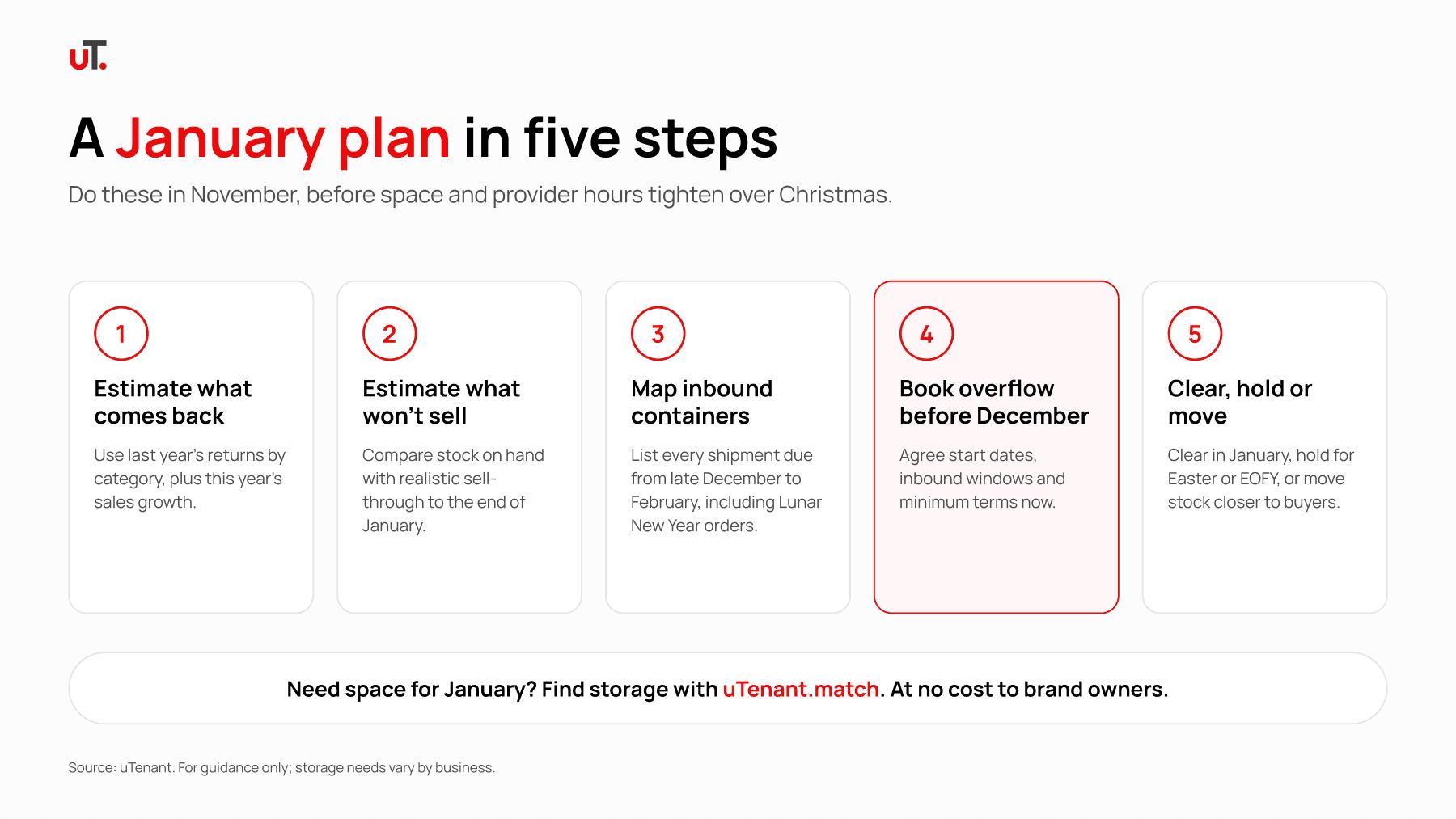
- Estimate what will come back. Use last year's returns data by category, then add this year's sales growth. Fashion, gifts and electronics usually return at higher rates.
- Estimate what won't sell. Compare stock on hand with realistic sell-through to the end of January, not the end of December.
- Map your inbound containers. List every shipment due between late December and February, including orders brought forward for Lunar New Year.
- Book overflow before December. Some providers run reduced hours between Christmas and New Year, and the best-located space goes first. Agree start dates, inbound windows and minimum terms now.
- Decide what to clear, hold or move. Some stock is worth holding for Easter or EOFY. Some is worth clearing in January. Some belongs in a different city closer to its buyers.
Questions to ask any overflow storage provider
- What are your operating hours and inbound cut-offs between 22 December and 12 January?
- Can you receive, inspect and re-label returned stock, or only store pallets?
- What is the minimum term, and how much notice do I need to give to leave?
- Do you charge per pallet per week, and what inbound, outbound and handling fees apply?
- Can I see stock levels online, or do I rely on emailed reports?
- How close are you to my customers, my returns flow and my port?
Compare 3PL quotes side by side with uTenant.match
uTenant.match is built for exactly this kind of short-term need. You tell us how many pallets, where, when and for how long. We take your request confidentially to vetted 3PLs at 151 locations across Australia and New Zealand, bring back itemised offers you can compare side by side, and help you onboard. There is no cost to brand owners.
Recently, a Melbourne business needing space for 800 pallets received 5 tailored offers the same day. The earlier you tell us what's coming, the more of the market you can choose from. Holding thousands of pallets with a 3PL? Tell us your volumes once and compare offers before your contract renews.
Disclosure: uTenant is backed by JLL. JLL figures in this article are taken from JLL's published research.
Plan for the month after
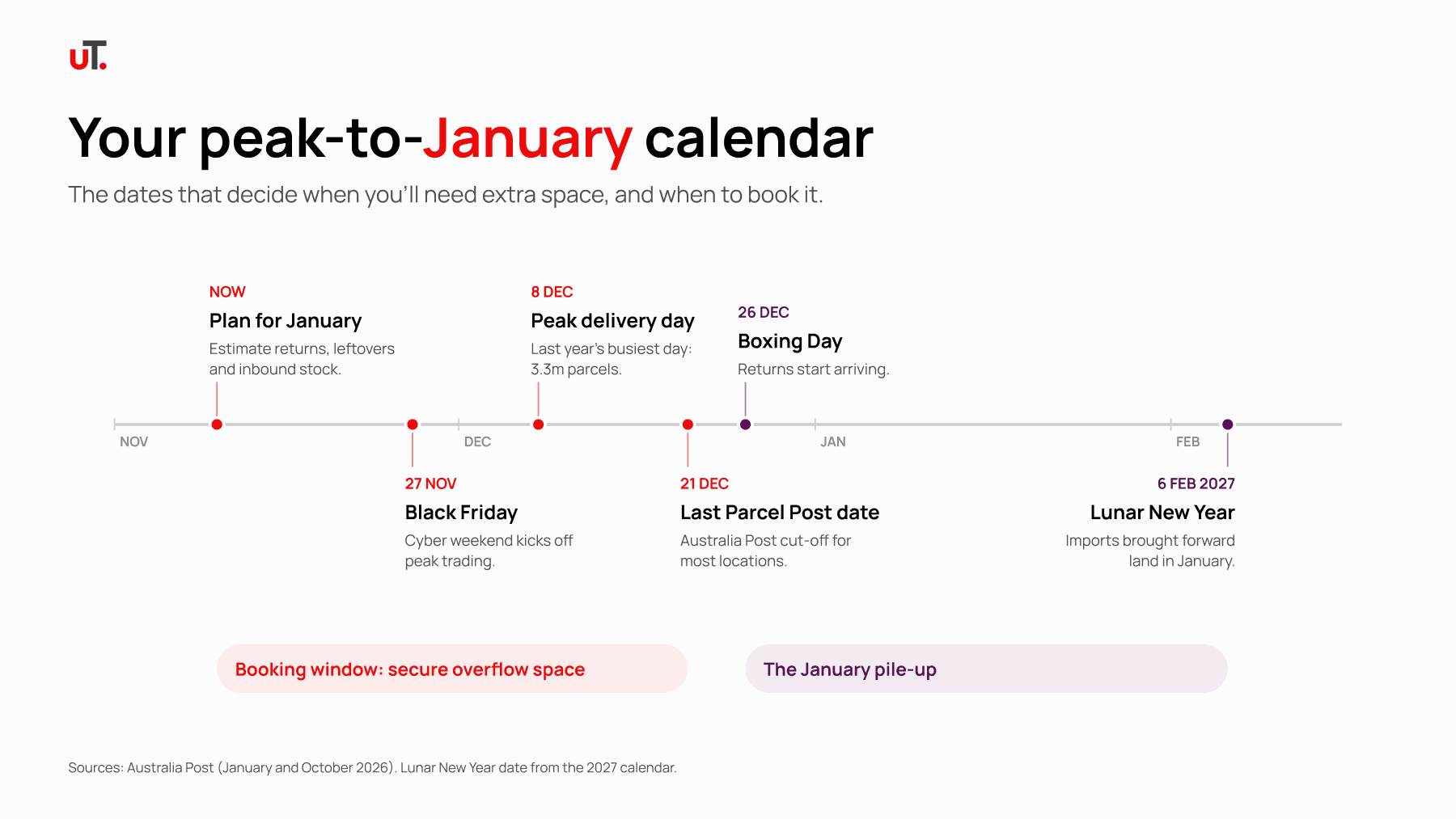
Black Friday is on 27 November. Australia Post's last Parcel Post sending date for most of the country is 21 December. Your January plan needs to be in place before both.
Need space for January? Find 3PL warehouse space with uTenant.match and tell us what's coming back.
Frequently asked questions
What is overflow storage?
Overflow storage is short-term warehouse space used when stock exceeds what your main warehouse or 3PL can hold. It is usually booked by the pallet for weeks or months, without a long lease.
When is the busiest time for returns in Australia?
Returns rise straight after Christmas and continue through January. eDesk reported a 45% increase in return requests in the post-Christmas period of 2025.
Is warehouse space hard to find in Australia right now?
It is getting harder. JLL reports national industrial vacancy fell to 4.6% in the September quarter of 2026, prime vacancy fell to 3.7%, and new completions fell to their lowest level since 2021.
How far ahead should I book overflow storage for January?
Aim to confirm space in November or early December. Some providers reduce hours between Christmas and New Year, and the best-located space is taken first.
How much does overflow storage cost?
Rates vary by city, product type, handling and term. To see real rates for your volumes, request itemised offers from 3PLs with space on uTenant.match; final rates depend on your needs, product movement and provider.
How do I compare 3PL quotes?
Ask every provider to price the same things on the same terms: storage per pallet per week, inbound and outbound handling, pick and pack, and minimum term. Itemised rate cards side by side make the real difference clear. uTenant.match does this for you, with offers from 3PLs with space returned in one format.
Should I benchmark my 3PL rates before my contract renews?
Yes. Renewal is when you have the most leverage. Knowing what other 3PLs would charge for the same volumes helps you negotiate, or move if the gap is large. You can request offers confidentially, without your current provider knowing.
Sources
- JLL (14 October 2026), Record 1.49 million sqm of industrial take-up as national vacancy falls to 4.6 per cent
- JLL Research via Australian Manufacturing (15 October 2026), Australian industrial property demand hits record as vacancy falls to 4.6%
- JLL Research (17 August 2026), Q2 2026 Australian Industrial Market Analysis
- Australia Post via Inside Retail (15 October 2026), Why finishing peak strongly means looking beyond the sale
- Australia Post (19 January 2026), Biggest peak ever
- Retailbiz (19 January 2026), Australia Post delivers record 111 million parcels over peak season
- eCommerceNews Australia (17 December 2025), Retailers hit by Christmas returns hangover surge
- Reserve Bank of Australia (3 November 2026), Statement by the Monetary Policy Board: Monetary Policy Decision